
TLDR; The Short Answer
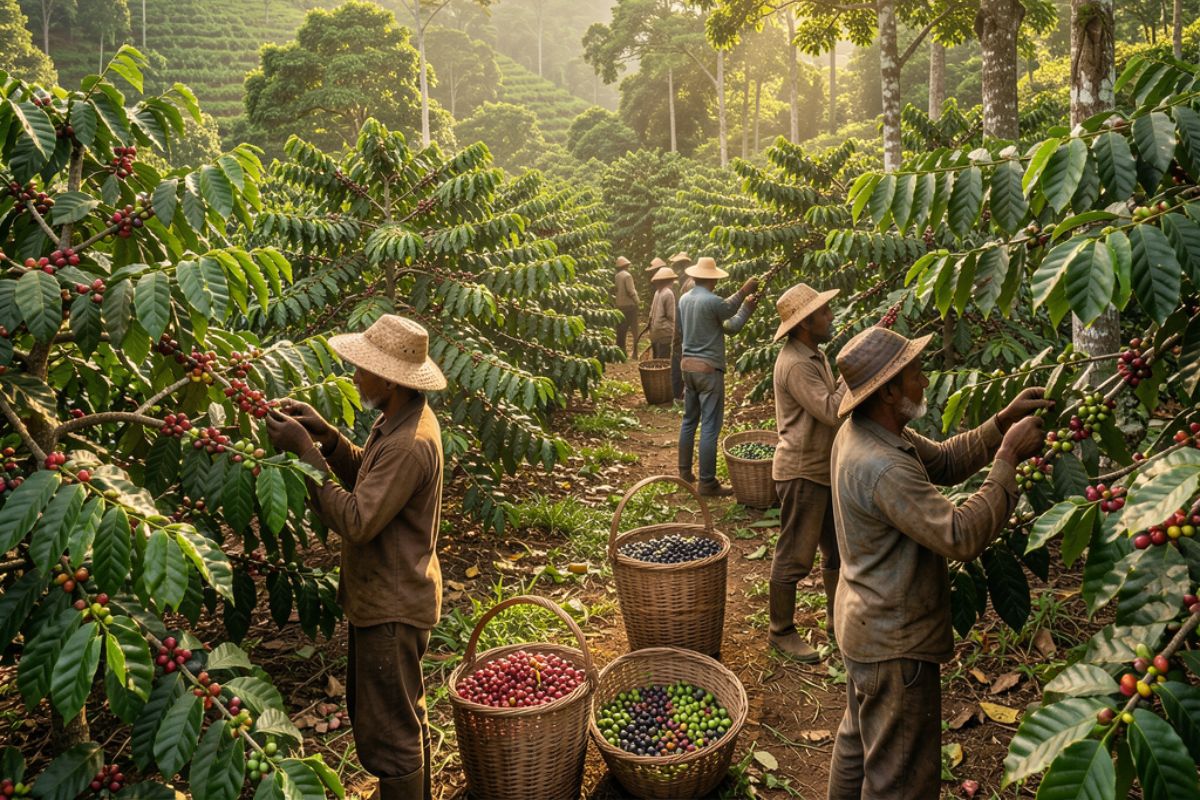
Coffee originated in the highland forests of Ethiopia, where the coffea arabica plant grew wild for centuries before anyone thought to brew it. From Ethiopia it traveled to Yemen, where Sufi monks first cultivated and roasted it in the 15th century. From Yemen it spread to the Ottoman Empire, across North Africa, into Europe, and eventually to the Americas — carried by colonizers, traders, and religious orders who understood, sometimes only dimly, that they were transporting something that would change the world. Costa Rica received coffee in the late 18th century and became the first Central American country to commercialize it commercially, building a national identity and economic foundation on a crop that, three centuries later, Cafe Milagro is still roasting in downtown Quepos.
This is the story of how a small red berry from the African highlands became the second most traded commodity on earth and the daily ritual of over two billion people.
The Legend of Kaldi — Where the Story Begins
Every great origin story deserves its myth, and coffee's is one of the best.
Sometime around the 9th century CE — the exact date, like most of this period, exists more in tradition than in documented record — a goat herder named Kaldi was tending his flock in the Kaffa region of what is now Ethiopia. He noticed that on certain evenings, after grazing on the berries of a particular shrub, his goats refused to sleep. They danced, the story goes, through the night with an energy that had no natural explanation.
Kaldi brought the berries to a nearby monastery. The head monk, reportedly skeptical of anything that interfered with the contemplative sobriety his order required, threw the berries into a fire. What followed changed the course of human history: as the berries roasted in the flames, an extraordinary aroma filled the room — the first recorded instance, in legend at least, of roasted coffee fragrance meeting human nostrils. The monks raked the roasted beans from the fire, dissolved them in hot water, and discovered that the resulting beverage kept them alert through the long hours of evening prayer.
The Kaldi legend is almost certainly embellished. But the Ethiopian origin of coffea arabica is not legend — it is botanical fact. The species is native to the highland forests of southwestern Ethiopia, where it still grows wild today in the Kaffa, Jimma, and Sidama regions. Every cup of arabica coffee ever drunk anywhere in the world traces its genetic lineage to those forests. Including every bag that leaves Cafe Milagro's roastery in Quepos.
Ethiopia and Yemen: The First Thousand Years
The transition from wild Ethiopian forest plant to cultivated and intentionally consumed beverage took several centuries and almost certainly involved Yemen as the crucial intermediary.
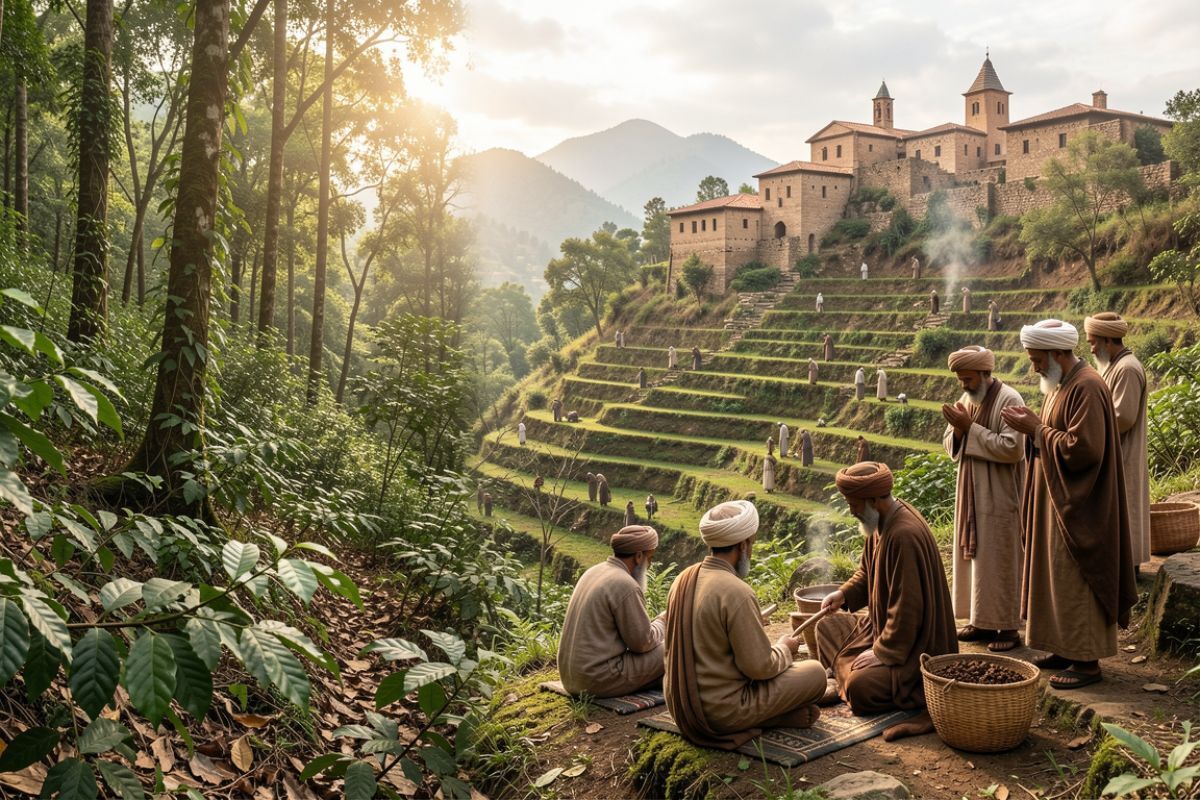
By the 15th century, Sufi monks in Yemen were cultivating coffee plants on the slopes of the Yemeni highlands — the terraced mountain farms of the region known as Al-Makha, or Mocha, which would later lend its name to one of the world's most recognized flavor descriptors. The Sufis discovered that coffee's alertness-producing properties were ideal for their practice of dhikr — extended nighttime devotional sessions involving chanting, prayer, and meditation. Coffee was, from its first intentional cultivation, a spiritual tool as much as a beverage.
From the Yemeni monasteries and farms, coffee spread rapidly to the broader Islamic world. Yemen jealously guarded its monopoly for as long as it could — exporting only roasted or boiled beans to prevent cultivation elsewhere — but the plant's spread was ultimately unstoppable. By the early 16th century, coffeehouses — qahveh khaneh — had appeared in Mecca and Cairo, and the social institution that would shape the next five centuries of global culture was born.
The Coffeehouse: Where the Modern World Was Assembled
The coffeehouse is one of the most consequential inventions in the history of human civilization, and it is not always recognized as such.
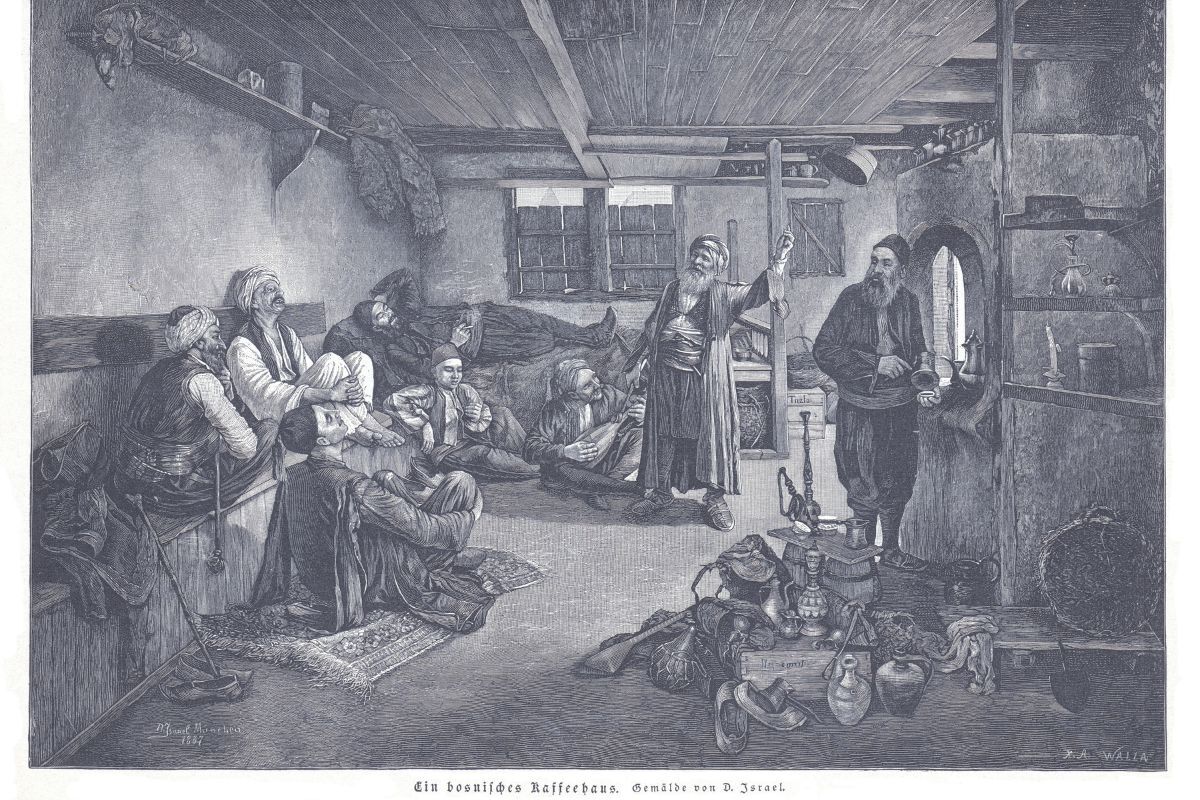
Before the coffeehouse, the primary social venue for most of the Islamic world — and soon, Europe — was either the private home or the tavern. The home was exclusive; the tavern produced intoxication. The coffeehouse offered something neither could: a sober, public, intellectually charged space where men of different classes could sit, talk, argue, read, conduct business, and exchange ideas for the price of a cup.
The effects were revolutionary — sometimes literally.
In the Ottoman Empire
The first coffeehouses in Constantinople opened around 1554, during the reign of Suleiman the Magnificent, and immediately became centers of intellectual and political discourse that made the Ottoman authorities profoundly uncomfortable. Coffee was banned twice in the 16th century — once by a local governor of Mecca who decided the gatherings it enabled were seditious, and once by Sultan Murad IV, who punished coffee drinking with death. Neither ban lasted. The coffeehouse was too useful, too popular, and too deeply embedded in urban social life to suppress.
In Europe — The Penny Universities
Coffee reached Europe through the Venetian trade routes in the early 17th century and spread with extraordinary speed. By 1650 there was a coffeehouse in Oxford; by 1663, over 300 in London alone.
The London coffeehouses became known as "penny universities" — for the price of a penny (the cost of admission and a cup of coffee), any man could sit for as long as he wished, read the newspapers available at each establishment, and participate in the conversation of the room. The social leveling this enabled was genuinely radical in a hierarchical society — a merchant could sit beside an aristocrat, a clerk beside a philosopher, and the currency of the space was ideas, not birth.
What happened in those rooms changed the world in ways that echo today:
Lloyd's of London — the insurance market that became one of the foundations of global capitalism — began as a coffeehouse. Edward Lloyd's establishment near the Thames was the gathering place of ship captains, merchants, and underwriters who needed a reliable place to conduct maritime insurance business. The custom of the room became the institution, and the institution became one of the most influential financial organizations in history.
The London Stock Exchange began in Jonathan's Coffee House, where brokers gathered to trade shares in the early 18th century. The modern financial system was assembled, cup by cup, in a coffeehouse.
The Enlightenment — the philosophical and scientific revolution that gave the modern world its foundational ideas about reason, democracy, and human rights — had the coffeehouse as its primary social infrastructure. Voltaire reportedly drank forty cups of coffee a day. Jonathan Swift, Alexander Pope, and John Dryden frequented Button's Coffee House. The conversations that produced the Declaration of Independence and the French Revolution were conducted, refined, and argued over coffee.
The tavern had given Europe beer, which is nutritious but sedating. Coffee gave Europe something it had never quite had before: a sober, stimulating, democratizing social space in which the ideas of the modern world could be built.
Coffee Crosses the Atlantic: The New World
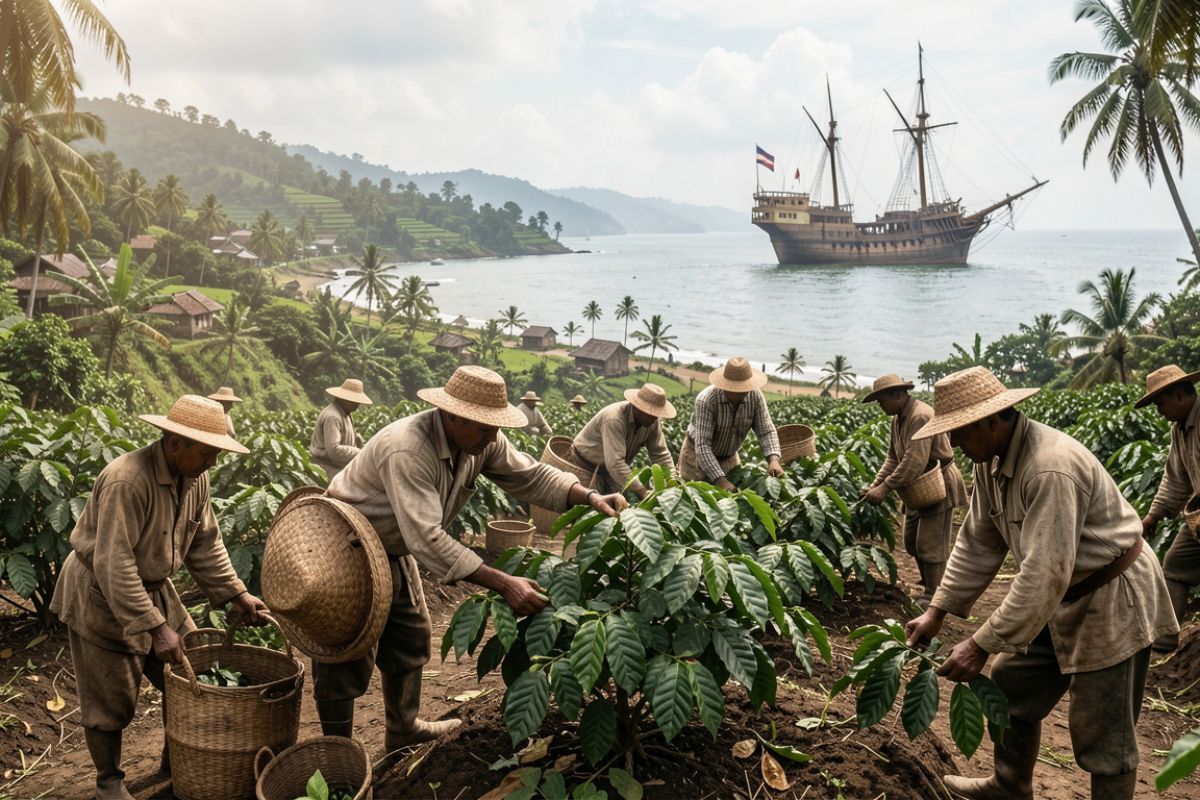
The Dutch were the first Europeans to successfully cultivate coffee outside Yemen, establishing a plantation on the island of Java (in what is now Indonesia) in 1696. From a single plant smuggled out of a Yemeni port — the monopoly had finally been broken — they built a coffee empire that made Amsterdam the center of the global coffee trade and established the word "Java" as a synonym for coffee in the English language.
The French followed, bringing coffee to the Caribbean island of Martinique in 1720. From a single seedling — carried, according to one of history's more romantic accounts, across the Atlantic by a French naval officer named Gabriel de Clieu, who shared his own water ration with the plant during a drought at sea — the entire coffee cultivation of the Americas descended.
From Martinique, the plant spread to Haiti, then to Brazil (which would eventually become the world's largest coffee producer), then north and south through the Caribbean basin and into Central America. By the late 18th century, coffee was growing in suitable climates throughout the tropical Americas, transforming ecosystems, economies, and societies as it went.
Costa Rica: The Nation That Coffee Built
Coffee arrived in Costa Rica in the late 18th century, with the first documented cultivation records dating to around 1779. What happened next was extraordinary and historically unique — and it laid the foundation for everything Cafe Milagro does today.
The Gift of the Beans
In the early 19th century, as Costa Rica's newly independent government (independence from Spain came in 1821) sought economic development strategies for a poor and sparsely populated nation, coffee emerged as the most promising crop. The government made a decision that would define the country's trajectory: it gave away coffee seedlings to anyone willing to plant them, and granted land to settlers who would cultivate it.
This was not a policy — it was a transformation. Within decades, the Central Valley surrounding San José was carpeted in coffee plants, and Costa Rica had a commercial export crop that would finance the construction of roads, schools, government buildings, and the Teatro Nacional — the national theater in San José, built in 1897 and still one of the most beautiful buildings in Central America, funded entirely by a tax on coffee exports.
The Ox-Cart Road to the Pacific
For Costa Rica's early coffee economy to function, the crop had to reach international markets. The first solution was the ox-cart route from the Central Valley to the Pacific port of Puntarenas — a journey of days across mountain terrain, conducted by the brightly painted wooden ox-carts that became one of the most recognizable symbols of Costa Rican national identity. The ox-carts of Costa Rica, with their intricate geometric painted designs unique to each region and family, are today a UNESCO Intangible Cultural Heritage of Humanity — born directly from the coffee trade.
The first railroad to the Caribbean coast, completed in 1890 after years of brutal construction through jungle and mountains, opened an Atlantic shipping route to Europe and transformed the economics of the export. Costa Rica's coffee was reaching the tables of Europe regularly by the mid-19th century, and its quality — grown in volcanic soil at altitude, processed with care — had already established a premium reputation.
The Social Contract of Coffee
Costa Rica's coffee economy developed differently from most of Latin America, and the difference matters. In many coffee-producing countries, the industry concentrated land and wealth in the hands of a small oligarchy — large haciendas worked by landless laborers in conditions that were frequently coercive or exploitative.
Costa Rica, by contrast, developed a smallholder culture — a landscape of family farms rather than plantations — partially by design (the government's seedling-distribution policy) and partially by the topography of the Central Valley, which favored smaller parcels over vast estates. The result was a coffee economy with a broader base of participation, a stronger rural middle class, and a democratic political tradition that was genuinely rooted in the lived reality of the coffee-farming community.
This is the heritage that the farms Cafe Milagro sources from today are part of. The families we work with in Tarrazú, the West Valley, and beyond are in many cases the third, fourth, and fifth generation of farmers who received those original seedlings, built those original ox-cart routes, and created the national identity that Costa Rica still carries. When you drink a cup of Cafe Milagro coffee, you are drinking from that lineage.
The 20th Century: Coffee Becomes a Global Commodity — and Its Problems Begin
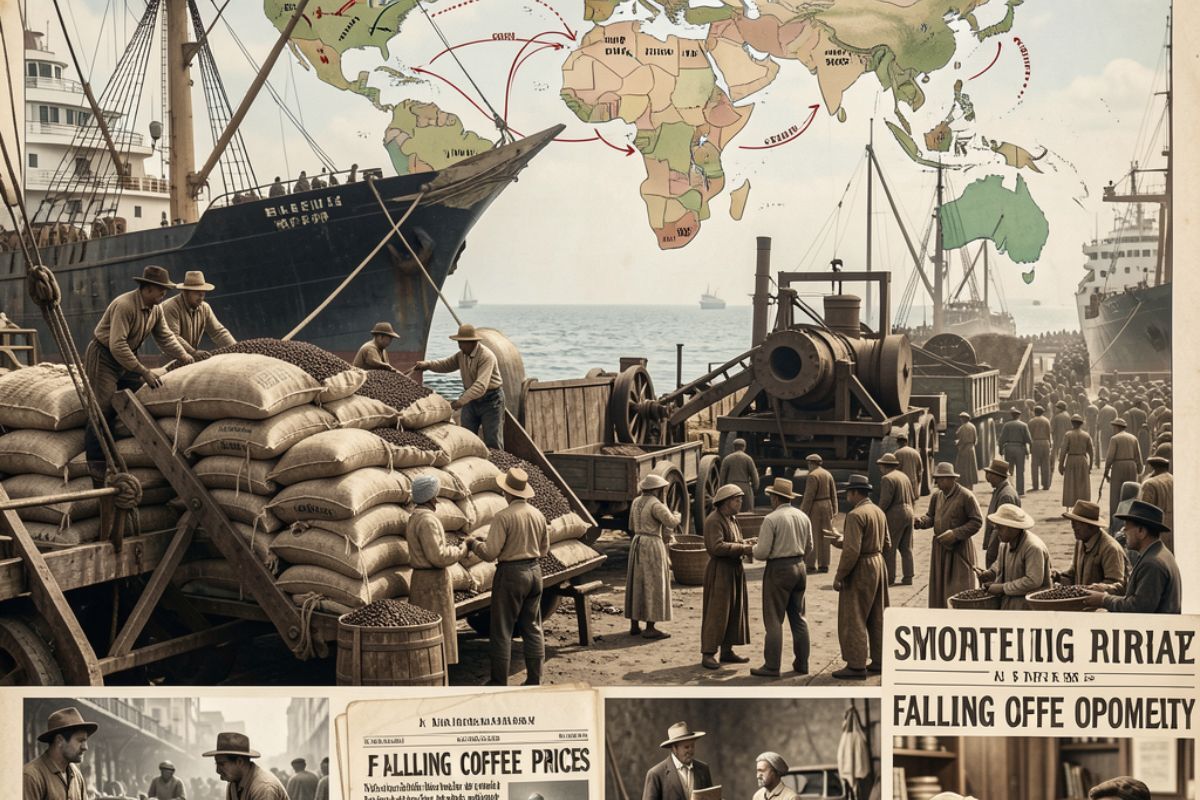
The 20th century transformed coffee from a regionally significant crop into a globally traded commodity — and in doing so, created the structural problems that define the modern coffee industry and that the specialty movement exists, in large part, to address.
The Commodity Market and the C Price
The establishment of the New York Coffee Exchange in 1882 — formalized over subsequent decades into what is now the ICE Futures market — created a mechanism for trading coffee as a standardized commodity, divorced from its origin, its quality, or the human cost of its production. The "C price," as the global benchmark coffee price is known, is set by futures traders in New York and London who have never visited a coffee farm and whose primary interest is in price movement, not in the sustainability of the supply chains they're trading.
For most of the 20th century, this system kept coffee prices at levels that routinely fell below the cost of production for small farmers — a structural dynamic that drove rural poverty across the coffee-producing world, incentivized the kind of agricultural intensification that degraded land and ecosystems, and transferred wealth from growing countries to trading and consuming countries with systematic efficiency.
The Rise of Commercial Coffee
Alongside the commodity market, the 20th century saw the rise of large commercial coffee roasters — Folgers, Maxwell House, Nescafé — who optimized for consistency, scale, and shelf life rather than quality, freshness, or provenance. These companies pioneered the use of robusta coffee (lower quality, higher yield) blended with arabica to reduce costs, and introduced consumers to a version of coffee that was reliable but far removed from what the best growing regions could actually produce.
The vacuum-sealed can, the freeze-dried instant granule, the supermarket shelf with a six-month best-by date — these innovations expanded coffee's reach enormously while simultaneously lowering the ceiling on what most consumers expected from it.
Costa Rica pushed back. In 1989, as described in Cafe Milagro's exploration of Costa Rican coffee regions, the country legally banned robusta cultivation entirely — an extraordinary act of national quality commitment in a market that was relentlessly racing toward cheaper and lower.
The Specialty Revolution: Coffee Finds Its Way Back
The specialty coffee movement — the cultural and commercial shift that produced the third-wave cafés, the farm-to-cup roasters, the pour-over bars, and the genuinely extraordinary coffee available today — was in many ways a return. A return to the values that defined the best coffee of the pre-commodity era: origin transparency, craft roasting, direct relationships with farmers, and the belief that a cup of coffee could be as complex, nuanced, and worthy of attention as a glass of fine wine.
The movement gained coherence with the founding of the Specialty Coffee Association of America in 1982, accelerated through the 1990s with the rise of roasters like Stumptown and Intelligentsia, and reached mainstream cultural visibility in the 2000s and 2010s as pour-over bars, single-origin menus, and the vocabulary of terroir entered the vocabulary of urban food culture globally.
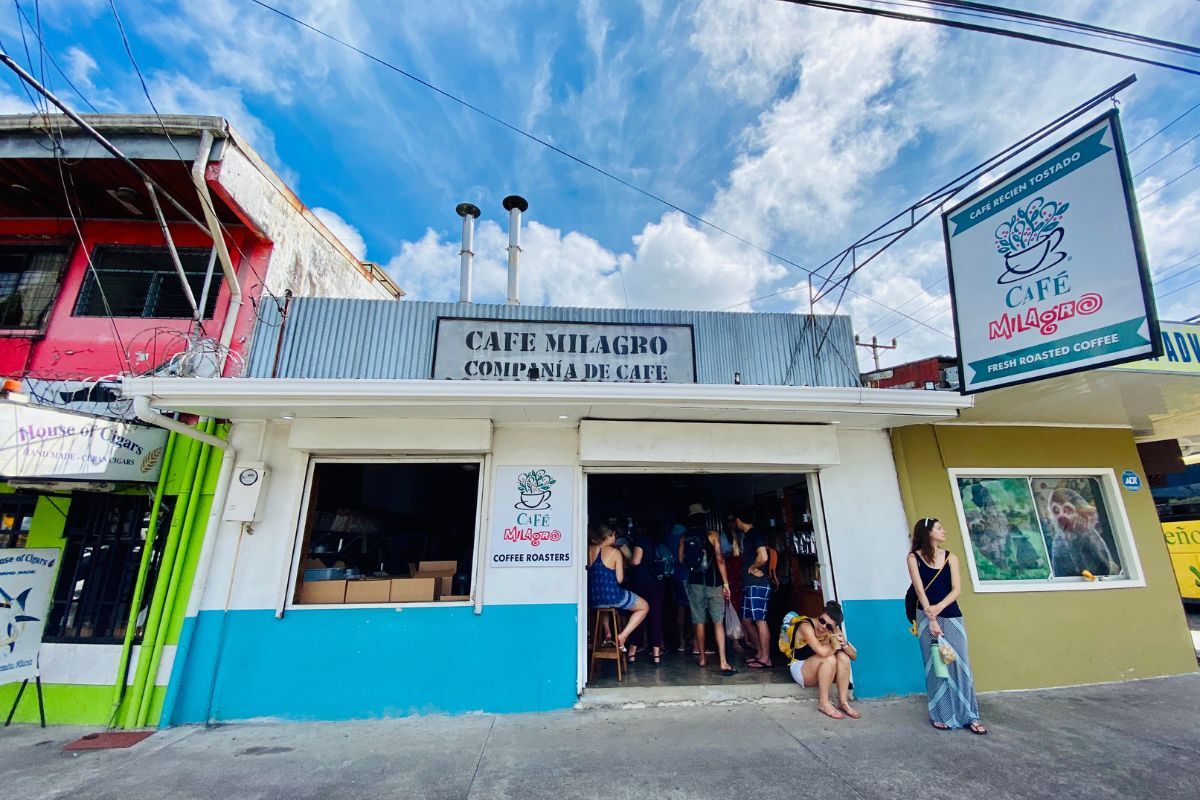
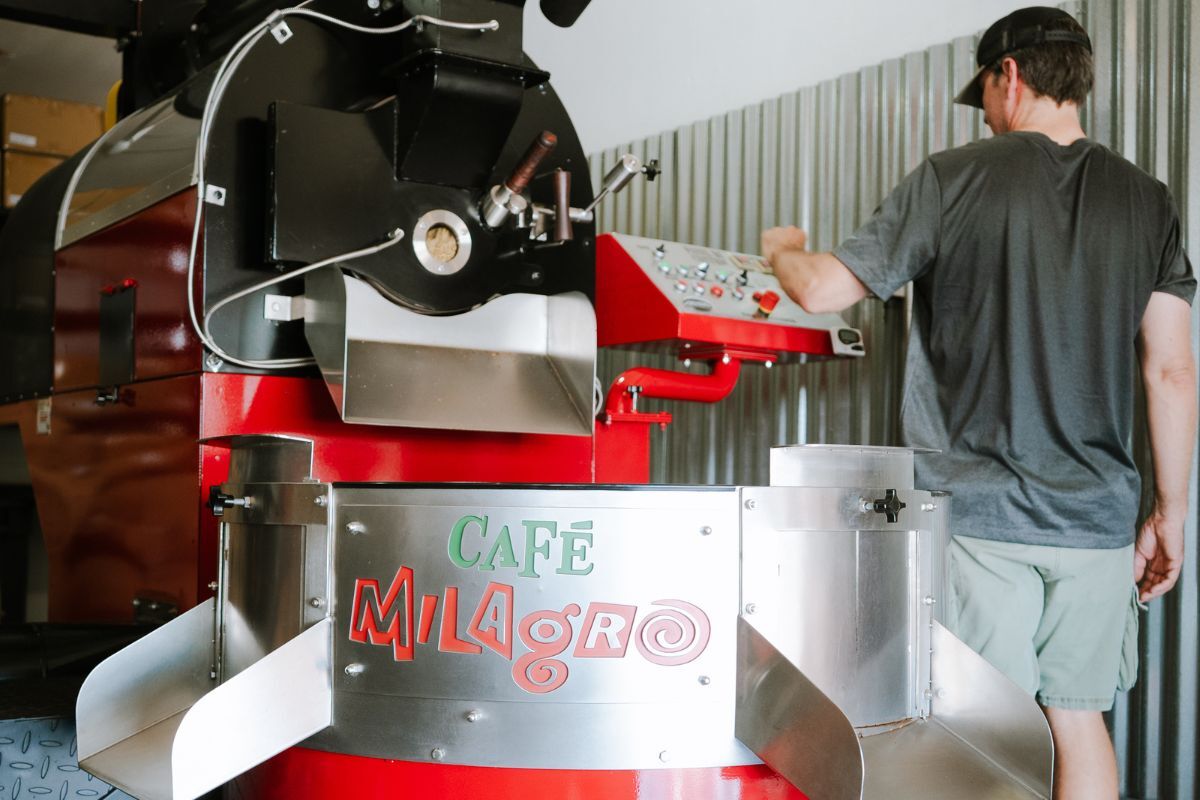
What is less often acknowledged is that roasters like Cafe Milagro — operating in origin countries, sourcing directly from farm partners, roasting at altitude with an intimate knowledge of the specific beans they were working with — were practicing the principles of the specialty movement before it had a name. Thirty years of direct farm relationships, high-altitude Costa Rican arabica, and roasting-to-order from a facility in downtown Quepos is not a recent pivot toward specialty values. It is what Cafe Milagro has always done.
From Kaffa to Quepos: The Full Circle
There is something worth pausing on in the arc of this story.
Coffee began in the highland forests of Ethiopia — a wild plant in a biodiverse, ecologically intact landscape, encountered first by animals, then by people, then by monks seeking alertness for devotion. It spread through the Islamic world as a social and spiritual tool. It built the infrastructure of the European Enlightenment in London's penny universities. It crossed the Atlantic on a single seedling and transformed the economies of a hemisphere. It made Costa Rica the nation it is — funding its theater, its roads, its democratic institutions, and the smallholder farming culture that persists today.
And now it arrives in your cup from Cafe Milagro's roastery in Quepos — grown by farm families whose grandparents received government seedlings and built their lives around the same plant, roasted by a team that has been learning the craft for three decades in the same volcanic landscape that makes Costa Rican arabica extraordinary, shipped fresh within days of roasting to people around the world who have decided that what is in their cup matters.
The history of coffee is, at its core, the history of human beings discovering that something grown in the earth, treated with skill and care and respect, can produce an experience that connects them to each other and to the world. That has been true in Ethiopian monasteries and Ottoman coffeehouses and London penny universities and Costa Rican ox-cart roads and specialty roasteries in Manuel Antonio.
It is still true. Every morning. In every cup.
Frequently Asked Questions About Coffee History
Q: Where did coffee originate?
Coffee originated in the highland forests of Ethiopia — specifically in the southwestern regions of Kaffa, Jimma, and Sidama — where the coffea arabica plant grows wild to this day. The species is native to Ethiopia and is the genetic ancestor of every arabica coffee grown anywhere in the world. From Ethiopia, coffee cultivation spread to Yemen in the 15th century, where Sufi monks first roasted and brewed it intentionally, before spreading through the Islamic world and eventually to Europe and the Americas.
Q: Who discovered coffee?
The discovery of coffee is traditionally attributed to an Ethiopian goat herder named Kaldi, whose legend holds that he noticed his goats behaving with unusual energy after eating berries from a wild coffea plant and brought the berries to a local monastery. The monks then roasted and brewed the beans, discovering their alertness-producing properties. While the Kaldi legend is almost certainly embellished or symbolic, it reflects a genuine historical truth: coffea arabica is native to Ethiopia, and the first human use of the coffee plant almost certainly occurred there centuries before it was formally cultivated anywhere else.
Q: When did coffee come to Costa Rica?
Coffee arrived in Costa Rica in the late 18th century, with the first documented cultivation records dating to approximately 1779. In the early decades of the 19th century, following Costa Rica's independence from Spain in 1821, the government actively promoted coffee cultivation by distributing free seedlings to settlers and granting land to those who would plant it. Costa Rica became the first Central American country to develop a commercial coffee export industry and by the mid-19th century was regularly supplying premium coffee to European markets. The proceeds funded much of Costa Rica's national infrastructure, including the country's national theater.
Q: Why is Costa Rica important in coffee history?
Costa Rica holds a unique place in coffee history for several reasons. It was the first Central American country to commercially cultivate and export coffee, using the proceeds to build democratic institutions and national infrastructure in the 19th century. It developed a smallholder farming culture — family-scale farms rather than large plantations — that produced both a more equitable economic distribution and a more sustainable agricultural model than most of the coffee-producing world. And in 1989, it became the first country in the world to legally ban the cultivation of robusta coffee, committing by law to producing exclusively the higher-quality arabica variety. These decisions define Costa Rican coffee culture today.
Q: What were coffeehouses historically?
Coffeehouses were the defining social institutions of the Islamic world from the 16th century and of Europe from the 17th century — public spaces where, for the price of a cup of coffee, any man could sit, read, discuss, and conduct business in a sober environment. The London coffeehouses of the 17th and 18th centuries were known as "penny universities" and served as the social infrastructure for the Enlightenment, the development of modern finance (Lloyd's of London began as a coffeehouse), and the early stock exchange. The coffeehouse created, for perhaps the first time in history, a genuinely public intellectual space that was democratically accessible and not organized around alcohol.
Q: What is the specialty coffee movement?
The specialty coffee movement is a cultural and commercial shift in the global coffee industry — beginning formally in the 1980s and accelerating through the 2000s and 2010s — that prioritizes coffee quality, origin transparency, direct relationships with farmers, and craft roasting over the commodity-grade consistency and low-cost blending that dominated 20th-century commercial coffee. Specialty coffee is typically defined as coffee scoring 80 points or above on the Specialty Coffee Association's 100-point scale, produced from arabica beans, traceable to specific origins or farms, and roasted by producers who understand and work to express the specific character of each lot. Cafe Milagro has practiced specialty coffee principles from its founding in 1994.
Q: How did coffee change the world?
Coffee changed the world in at least three distinct ways. First, as a stimulant, it shifted human productivity patterns — replacing alcohol as the primary social beverage in many cultures and enabling a sustained, alert form of cognitive work that beer and wine did not support. Second, the coffeehouse created a new kind of democratic public space that served as the social infrastructure for the Enlightenment, modern finance, journalism, and political revolution. Third, as a commodity, coffee reshaped the economies and landscapes of dozens of producing countries — building national infrastructures in places like Costa Rica, funding colonial extraction in others, and creating the global supply chain dynamics that the specialty coffee movement is, in many ways, still working to correct.
From the highlands of Ethiopia to the volcanic slopes of Costa Rica to your cup — explore Cafe Milagro's freshly roasted single-origin coffees, sourced from farm partners who are writing the next chapter of this story.